
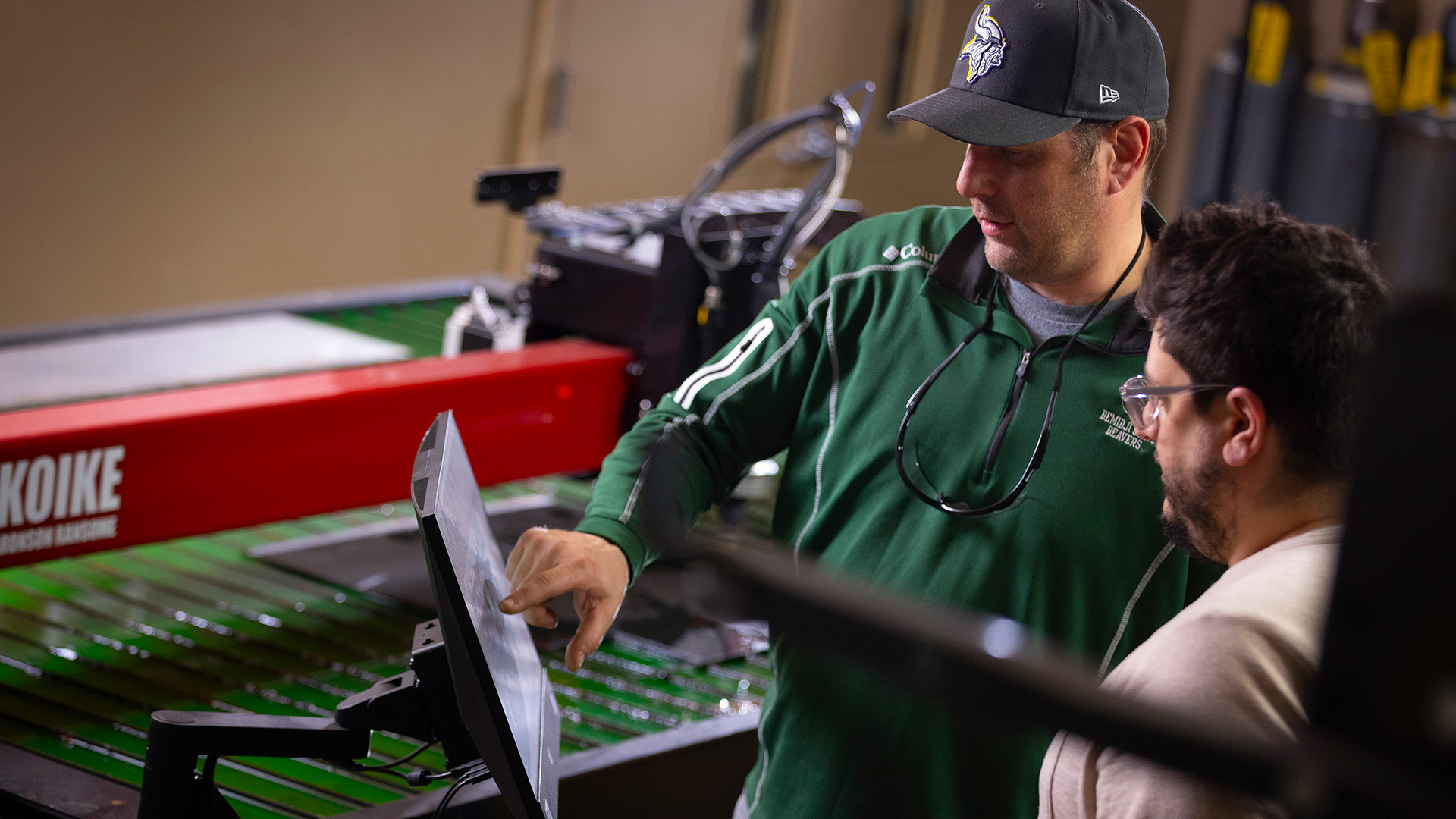
Bemidji State University is addressing Minnesota’s need for teachers in increasingly popular career and technical education (CTE) fields through two new bachelor’s degree programs.
Through its innovative School of Technology, Art and Design, teachers have an unparalleled opportunity to pursue BSU bachelor’s degrees that lead to state licensure in construction careers in CTE and art & communication technology in CTE.
Dr. Peter Johnson, associate professor of career and technical education, says BSU’s programs are unique in Minnesota.
“We’re the only four-year university offering an undergraduate degree pathway to complete licensure,” he said. “Anybody who wants to be a middle- or high-school career and technical education teacher can do that here.”
Interest in Minnesota’s CTE programs has exploded in recent years. Between 2022–24, more than 100,000 students engaged in advanced career-connected learning, according to the Minnesota Service Cooperatives — a state-level organization that supports and trains CTE teachers. That student interest has, in turn, created a significant demand for qualified, trained CTE instructors.
Both categories of CTE licensure offered at BSU are classified by the state as shortage areas for licensed teachers. A statewide job listing maintained by the agency overseeing professional development, mentoring and preparation for Minnesota’s CTE teachers shows more than 60 available jobs. Those open jobs tend to be well-paying. U.S. Bureau of Labor Statistics data for 2023 shows that Minnesota middle school teachers with CTE credentials earn, on average, about 16% more than those without the credential, while high school CTE teachers earn about 3% more.
“The big picture is a huge shortage of career and technical education teachers,” Johnson said. “We need well-trained teachers to meet student needs and bring the skills needed for these programs into their classrooms.”
Bemidji State’s CTE programs offer pathways to Tier 2 and higher teaching licenses in Minnesota, which require at least enrollment in an approved teacher preparation program. Johnson says bachelor’s degrees not only open doors to an in-demand credential but also offer permanent-licensure pathways for those currently teaching with a temporary license.
“Minnesota has about 900 teachers currently teaching on a temporary or out-of-field position permissions,” Johnson said. “One of the requirements to maintain a temporary license is to be enrolled in a program working toward a bachelor’s degree.”
The program also opens doors for school districts, as federal Perkins V grants require CTE teachers to be licensed. Perkins funding provides nearly $1.4 billion in annual support for career and technical education programs. It can provide school districts with salary support for qualified teachers, funding for equipment and other benefits.
BSU’s CTE licensure programs build on the advantages of the university’s innovative School of Technology, Art & Design to offer students a unique, multidisciplinary pathway to teacher licensure. In addition to 19 credits of professional education credits:
- Construction Careers in CTE requires students to complete 33 credits in technology-related courses.
- Art & Communications Technology in CTE requires 36 credits of design-related courses, plus an additional four credits of electives.
“Bemidji State can provide training for every area under these credentials,” Johnson said. “Whether it’s under construction, communication, manufacturing, design or the visual or digital arts, what we can do here is unlimited. We have the equipment and the classes to provide teachers with everything they need to be successful.”
Both pathways require a CTE-specific core of five classes that students can complete online. In addition to foundational and theory courses, the core includes state Professional Educator Licensing and Standards Board-approved, CTE-specific courses on classroom management, curriculum development and student assessment.
“The skills people don’t necessarily have when coming in from industry, we provide through these classes,” Johnson said. “To be a teacher, these skills are necessary.”
Creating Opportunity for Students
While advantages for CTE-credentialed teachers are apparent, CTE education is a proven success driver for high school students in those courses as well. Data from Minnesota’s Department of Education shows that 92% of students who enroll in two or more CTE courses will graduate from high school (compared to 84% of all students), and 65% will pursue a post-secondary education.
“The future of CTE is bright,” Johnson said. “Nobody is doing what BSU is doing, and I see our program growing into a top-notch example of what’s possible. We can do things at BSU that other universities can’t.”
SOURCES
- U.S. Bureau of Labor Statistics, Occupational Employment and Wages, May 2023
- Minnesota Department of Education, “Career and Technical Education“
- Minnesota CTE; job postings inventoried Dec. 3, 2025.