
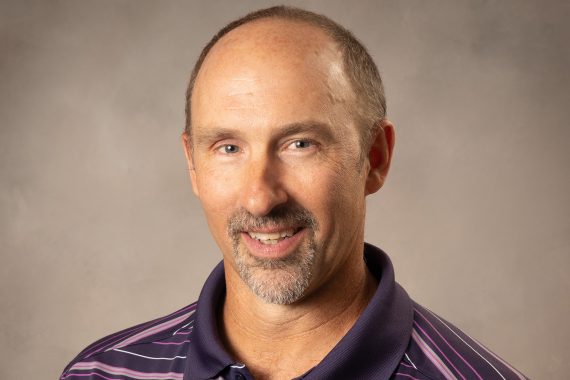
To Dr. Todd Frauenholtz, mathematics is about relationships.
The 25-year veteran Bemidji State University professor says those relationships go far beyond the “add, subtract, multiply, divide” mantra typically associated with math. They’re about the varied branches of mathematics and the students he works with every day.
“I have to bring experiences to my students in the classroom,” he said.
Through BSU’s Calculus I course, he has found opportunities to build those relationships with students in a variety of fields beyond math and math education majors.
“This range of students opens up connections,” he said. “Physics, chemistry, finance… These fields all have strong applications of calculus. Having this diverse group of students makes for more interesting discussions and strategies.”
“The more tools you have in your toolbox, the better you’re able to find the relationships.”
Those student relationships are built in what Frauenholtz calls a “thinking classroom,” where he discusses problems from the center of a room while surrounded by students working in groups. He says the format helps students gain valuable knowledge by examining how different groups bring their own experiences and perspectives to solutions for the same problem.
“If you’re talking about calculus, you can find solutions this way or that way or a different way,” he said. “The more tools you have in your toolbox, the better you’re able to find the relationships.”
Frauenholtz said the thinking classroom model also helps students overcome hesitations about seeking input when problems become difficult to solve — a life skill that translates far beyond the mathematical realm.
He said he wants students to realize that learning mathematics is hard work and is challenging for everyone in the class. However, by putting in the effort and cooperating with their peers, everyone can succeed.
“They have opportunities to be challenged, but in a supportive environment,” he said.
Beyond his classroom teaching assignments, Frauenholtz also plays a crucial role in the management of three grant-funded programs that support the training of future generations K-12 math and science teachers and STEM professionals.
Two programs are federally funded by the National Science Foundation through the Robert Noyce Teacher Scholarship Program. In both Noyce-funded programs, Frauenholtz collaborates with Dr. Jenna O’Dell, associate professor of mathematics at BSU.
The Noyce scholarship programs provide full cost-of-attendance scholarships and access to program-specific student support services and specialized training. Frauenholtz’s program supports math teachers, while the program lead by O’Dell is for prospective teachers in any STEM field — which at BSU includes teaching credentials in mathematics, chemistry and biology (which includes life science and earth & space science).
Frauenholtz said the math program has been remarkably successful. Of the 22 students who have graduated from the mathematics-focused Noyce program, 21 are currently teaching in high-need Minnesota classrooms.
“It gives our students scholarship money to help complete their degrees and training they wouldn’t get otherwise.”
Frauenholtz also collaborates with Dr. Katie Peterson, professor of chemistry, on her STEM Scholars program. It supports under-resourced and often under-represented students in science, technology, engineering and mathematics degree programs.
Frauenholtz says the success of these programs demonstrates their value, not only for BSU students interested in becoming teachers, but also for the schools they eventually serve.
“It gives our students scholarship money to help complete their degrees and training they wouldn’t get otherwise,” he said. “For the schools, it provides them with teachers. It’s a win-win.”
Frauenholtz says the scholarships can impact generations of a student’s family. STEM Scholars grants are targeted toward first-generation college students.
“Being the first in your family to graduate from college and having a STEM degree significantly impacts the opportunities for your family going forward,” he said. “Your employment opportunities — and your earning potential — go to a higher level.”
These scholarship and support programs ultimately help Frauenholtz reinforce the value of relationships.
“If you and I are working together in a lab, at some point we will have to collaborate,” he said. “The relationship piece is important — you’re not just somebody from class, you’re a real person. With these programs, you know there is somebody out there who has your back.”